|
The Nation’s Blessing or Curse?
By Gwilym ab Ioan
As a starting point, to set the platform for this essay, it would be appropriate to read the words found in the Crown Commissioners’ report of 1847.
Quoted from The Royal Commission Report, 1847 (Part II page 66)
This report is referred to, by Welsh people generally, as “The Betrayal of the Blue Books” (an echo of the Long Knives Betrayal in the 5th Century). It is likely that this marks the exact spot where the modern deterioration in our self-awareness as a nation began, and linked to that, the reduction in the numbers of people who are able to speak the Welsh language today, and more importantly, who use it as the language of the workplace, the school and the home. Our nation’s basic understanding of our indigenous culture, history, literature, and our national heroes, is also disappearing - as is the understanding of our future direction – which is based on all the above and which is absolutely essential to maintain a healthy nation that will survive. In the quote we see the root of the ignorant mindset that may be seen to this day amongst some Welsh people, particularly in the more anglicised areas of the south – that is, that they think they no longer have a need of their language and culture in the modern world, and that there is no purpose in transferring it to their children, as they believe that it will be a burden to them. In March 1846, the Honourable Member for Coventry (a so called respectable Welshman by the name of William Williams) proposed that there should be an enquiry - in his words: "to examine the state of education in Wales and especially into the means afforded to the labouring classes of acquiring a knowledge of the English tongue". A detailed report, 1,252 pages long, was written and published on behalf of the Royal Commission in 1847. Three young barristers from London were chosen to prepare the report – and not one of them had the least knowledge or understanding about Wales, and probably had never even heard the Welsh language spoken, never mind any experience of education at the level of the working classes in the Wales of that period. They had depended heavily on second hand evidence volunteered by the Anglican clergy – many of whom were angered and embittered beyond belief by the growth of Nonconformity in Wales. They were only too pleased to give an unbalanced impression of inferiority to the researchers, to blacken the character of Nonconformity and its effects on the Welsh people. The Commissioners further relied on the answers given by monolingual Welsh speaking young children to questions posed to them in the only language spoken by the researchers - the language of the Crown - English. The poor unfortunate little children neither understood a word of the questions asked of them nor were they able to utter one word in reply in the foreign tongue. The wise men acting on behalf of the Crown came to the conclusion that the children’s failure to reply to questions was based on their innate stupidity, rather than on the researchers own abject failings to understand or speak a single word of the mother tongue of the children of Wales, as it commonly was at that time. No reasonable attempts were made to translate from one language to the other, and if it were attempted, the translation was often of a very poor standard. For example, some children were asked, "tell me how was Jesus killed?" The innocent, and correct, reply given by the majority was “drwy gael ei hoelio ar y pren syr” - and the translation recorded was "they seem to think he was nailed to a stick (pren – lit. wood fig. cross/rood) sir", to the amazement and horror of the researchers! Without a doubt, a great deal of what was said about the visible state of the schools and the lack of adequate teachers was reasonably correct, but the researchers went far beyond their brief, by accusing the majority of the residents of Wales of being uniquely degraded, lazy, stupid, unprincipled and sexually immoral. Furthermore, they noted that the Welsh language and Nonconformity were directly responsible for all these failings! A great deal of this unjustified and incorrect suspicion has survived to this day. Very few children in England have not heard the racist jingle: "Taffy was a Welshman, Taffy was a thief, Taffy came to my house, And stole a leg of beef." Or some other version of it. Think how often the Welsh are referred to as simple and stupid people, or worse, as reflected in the derogatory phrase "sheep shagger" which is used regularly to belittle members of our nation. To a great degree this impression has been created by those things that have become part of the image of Welsh people – through the influence of official reports such as “The Betrayal of the Blue Books”. Often, the proof of this is to be found in the reactions of people like Dr Vernon Coleman, a columnist in the weekly English newspaper, The Sunday People. Here is an example of his reply to a reader’s letter, published in that paper on 11th August this year: Reader’s letter: "We are English and live in Wales. When our daughter started school we were shocked to discover that she is being taught Welsh as a first language!"
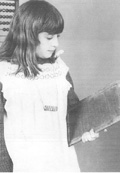
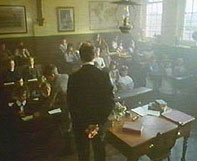
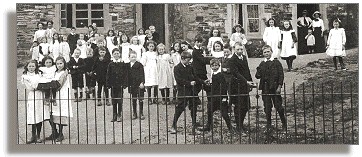
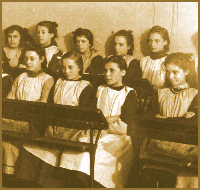
Dr Coleman’s reply: "In my view teaching Welsh as a first language is criminal. I think it's deliberately intellectually disabling a child. Find another school, or another country, where teachers are responsible enough to realise it is their job to prepare children for the real world rather than to indulge a few whimsical nationalists". That is obvious evidence, in 2002, of what we have inherited via the success of the black propaganda of the British (English) Empire, which has been fostered through the education system of England, Wales and Northern Ireland over a period of 132 years, from the days of Queen Victoria to this day. Such a comparatively short period is still within living memory (my great grandfather, who died when I was eight years old, was able to convey to me his personal experience of the use of the "Welsh Not"). The result of the efforts to find solutions to the deficiencies mentioned in the report in 1847 was the establishment of “Board Schools” throughout Wales. There were two other types of schools also, namely the “National Schools” and the “British Schools”, primarily run by religious organisations. The significant fact is that they were all monolingual English schools, and they concentrated, with conviction, on getting rid of the individual’s awareness of the Welsh language, and, even worse, their knowledge of Welsh culture and our history and heritage. The only saving grace was that initially, at least, the law was not strictly enforced and individual children were not forced to attend any school, so not many of the poor peasants’ children came under the influence of these schools. After the Reform Act gave the working classes the vote, and industry began to demand a more educated workforce, educating the working classes became a priority after 1867. The Compulsory Education Act that followed in 1870 provided a means of improving the previous deficiencies. Both National Schools and British Schools were allowed to continue, but where the provision was inadequate, “Board Schools” could be established, and they were non-denominational schools financed through local rates. Once the 1870 Statutory Education Act (known as the Forster Act), came into force, the Government now exercised direct control over education and dictated the terms through the power of its laws. Henceforth, there was no escape - the Board Schools had the right to compel parents to send their children to school – though it must be said that this was not realised, fully. In 1876 the Elementary Education Act came into force (the Sandon Act). This Act compelled parents to ensure that their children received an elementary education in reading, writing and arithmetic (in English, only, naturally). It also created Attendance Boards to compel parents to make sure that their children attended school in those areas where Board Schools did not exist. In 1880, another Elementary Education Act (the Mundella Act) extended the powers of the Sandon Act. This act made parents fully responsible for sending their children to school daily, between the ages of five and ten. On a superficial level, these acts may be regarded as beneficial, in terms of giving children a basic education where no such prior provision existed. The problem, of course, was that these laws went further than enforcing literacy on the children of Wales – they were tools to disconnect the nation from its roots, that is, its language, its culture and its history. The British Empire now empowered its government to finish the task of eliminating Wales as a country and nation that was unique and separate. Where the Tudor Acts of Union of 1536 and 1542 had failed to achieve that totally, the politicial processes between 1847 and 1880 saw the beginning of the end – through the political provision of education. Within four to eight generations down the line, the Welsh would be on their knees and on the verge of disappearing. Thus the vision of English Imperialism over the centuries (of assimilating Wales so that it was no more than a region of England, with the same language, laws, culture and education) would be realised, hundreds of years after the long campaign to assimilate the country by the sword had come to an end at the beginning of the fifteenth century – with the defeat of Owain Glyndwr’s (almost successful) revolution. Now, the teeth of the coloniser sank deeply into the flesh of the Welsh nation. The “Welsh Not” appeared. For those of you who are not familiar with this “enforcement order” here is a quote from the period when this punishment was in use:
The Welsh stick, or "Welsh", as it is sometimes called, is given to any pupil who is overheard speaking Welsh, and may be transferred by him to any school-fellow whom he hears committing a similar offence. It is then passed from one to another until the close of the week, when the pupil in whose possession the "welsh" is found is punished by flogging. Among other injurious effects, this custom has been found to lead children to stealthily visit the houses of their school-fellows for the purpose of detecting those who speak Welsh to their parents, and transferring to them the punishment due to themselves." - Henry Vaughan Johnson.
“Divide and conquer” tactics indeed – and extremely successful. It is nothing short of a miracle that our nation, although weak and fragile, has held on so long to its identity and language - a tribute to the basic obstinacy of a people of Celtic descent, perhaps?
This was a key factor. Previously, secondary education was only available to children whose parents could pay for it, and only those from more privileged backgrounds could afford it. The children of the poor stayed in primary school until they were fourteen – whatever their natural abilities – and then they would leave for a labouring job, or, if possible, to undertake an apprenticeship as a craftsman, although that, too, was something that not everyone could afford.
I am an example of this change. I can recall many a sermon from my father when I was at school “You make sure that you get on with your school work, otherwise your fate will be the same as mine – out in all weathers, with your lunch bag on your shoulder”. My father was a mason, scratching a living here and there (when work was to be had), whilst the rest of his time was spent struggling on an infertile smallholding on the slopes of Mynydd Bach, in deepest Ceredigion. Although an able child, he had left school at fourteen, like so many before him, because there was no opportunity for him to do otherwise, because of poverty. The fate of our family had been the same for countless generations; we had been born and raised in the same three room and half a bedroom cottage for ten generations at least; I know that because we can trace our family as far back as that through the oral tradition. I was the first to gain a higher education (apart from a great uncle who went on to become a minister, because he decided to remain single, and then went to work in a coal mine, far from home, whilst saving every scarce ha’penny to pay for his education, and that for many years without any spare time). I was the first generation to take full advantage of free education and I went on to graduate as an electronic engineer – there was no work for engineers of that sort in my native county. I was forced to work in the Anglicised towns of the south for nearly a quarter of a century, until my situation changed (purely by chance) and I had an opportunity to return home. Education! The saviour of the nation! But at what price to the nation as a whole, in the longer term? It was the education system of a foreign land that was being forced down our throats, and it was wholly inappropriate for our needs. Far worse, it has destroyed us as a nation. It needn’t have been so. Back in the 15th century Owain Glyndwr was planning an unique education system for Wales. His vision was astoundingly far-reaching and exceedingly “modern” and far ahead of its time. Owain himself was a scholar (because he was born into a privileged family) and he had pondered upon the effects of education on the ordinary people. He had instigated plans to establish totally Welsh universities in Wales and who knows what would have resulted for the nation by today, had he won the day, and had been able to realise his dreams? But that was not to be …..
Later, Sunday Schools were established during the period of Thomas Charles, Bala. It may be argued that this school was the most democratic of any type of school, with the most effective operation. It was a school for all, from children to adults. Its language was the language of the area where it was held. The teachers were chosen for their effectiveness, and they were easily moved from one class to the next, according to need, and where they operated most effectively. If they were not effective, they moved back, of their own volition, to the teachers’ class – where everyone was equal. The Literary Society was the secular equivalent of the Sunday Schools and they focused on the literature, poetry, culture and history of Wales. These subjects took the place of instruction about the history of the Jews, the Psalms and the Gospels. These schools have lasted until today in various forms within chapel society, though they are rapidly disappearing with the decline in the popularity of religion in the second half of the twentieth century. Without doubt, this is what has sustained the nation in terms of cultural, historical and linguistic education. By the beginning of the 20th century, the most aware amongst us could see the writing on the wall. It was apparent that each generation that went through the British /English education system in Wales became increasingly distanced from their roots and their awareness of their nation and identity. The language was rapidly disappearing in some areas – the sun was setting. Under the influence of Owen M Edwards, the Chief Insepctor of Schools in Wales from 1907 to 1920, the language was promoted in primary schools and Welsh language and literature were taught as subjects in the secondary schools. This resulted in slowing the decline of the language somewhat.
Without exception they all focused on the Welsh language, and that was a good thing. But, the decline in the numbers of Welsh speakers is a SYMPTOM of the disease. It is just like leaves withering on the tree – there is no purpose in expending energy on restoring the leaves if the tree is being poisoned through its roots – in the end, it will all die, and the leaves will disappear anyway. We see the same thing happening to this day, with the advent of organisations such as The Welsh Language Society, Language Initiatives, Welsh medium schools and playgroups etc. They are all focusing on restoring the leaves, without realising that it is essential for them to direct their efforts at the cause that is poisoning the tree. There are other organisations such as Cymuned that are working hard to keep the floodgates closed, and making sure that the process of decline is slowed down in the context of the traditional communities in the Welsh speaking areas – this has to be done, of course – I am member of that organisation’s Executive Committee myself – but all these efforts are only buying time. Some amongst us are naïve enough to believe that rescue is at hand because of the increasing growth in the number of people learning the language. They believe that the success of the Welsh medium schools in South Wales is a definite indication of this – they are deceiving themselves. With all due respect to each valuable learner amongst us, but it is possible to teach a parrot to speak Welsh – that does not make the parrot a Welshman, and that bird dos not count himself a member of an unique nation. If we look at the situation in the more Anglicised areas (in terms of language and culture) where the Welsh medium schools flourish, we see that the pupils learn to pronounce the language, often to a good, fluent level, but if we look more closely, we see that all the effort is a total waste, because these pupils, without exception, speak English at a social level, and also in the workplace, after they have left school at 16. Within a very short period of time, they have totally forgotten the language. Why? Because it is all a leaf restoring exercise – the tree continues to decay. Also, it must be admitted that a large percentage of parents send their children to Welsh medium schools because of the school’s general standard, and not because of any loyalty to the language. On the other hand, when people have been raised in full knowledge of their background and their culture, their heroes and their battles, the injustices against us over the centuries, it is almost impossible to hold them back from learning the language - it is the icing on the cake, it is something that arises naturally, and everyone takes a pride in it, and they protect it by making sure that is passed on to their children. It is a source of pride for them. Without that complete education, learning thousands of new words, in a dusty old language that is of no interest to anyone, is a chore. In such situations there is no inspiration available to provide a basis for learning the language seriously. Often, it is a totally artificial thing, and it often turns out to be a total waste of time. This is the graph that shows the fall in the numbers of people able to speak Welsh in Wales between 1891 and 1971 (the figures are derived from the official census archives, National Assembly for Wales). Remember, as I said previously, that it is the symptom of the disease that is reflected in the numbers that can speak the language, and still do so. Here, the language is used as a barometer to show what is happening generally. (The vertical bar graph axis shows the percentage of the population of Wales in it's entirety that could speak Welsh at each census and used it as their main social language. Horizontal axis shows decades from 1891 on the far left to 1971 on the right with the exception of 1941 when no census was conducted due to the activities of World War 2)
Interestingly, the decline shown in this graph is a linear one rather than a logarithmic one - as one would expect. This tells us that the basic reason for the decline is also a linear one. Obviously, there are several factors that have an effect on the numbers that are able to speak the language, but those effects, to a large degree, are to be seen at a more local level, and they are not reflected in the wider picture across the country as a whole. This graph shows the number of speakers as a percentage of the population of Wales as a whole. The chief factor, which has the effect of causing the decline, is something that had a strong and permanent influence on the nation – and that in a way that has been virtually unchanged over the 70 years viewed in the graph.
For example, look at what the most ineffective and undemocratic quango we have in Wales - the Welsh Language Board - has to say about the decline in the numbers of welsh speakers (whose current chairman is himself an ex public schoolboy, and who is, it is rumoured, about to send his own son to Eton). They say that the decline is due directly to the following factors – and nothing else. I quote:
Let’s deal with the first. The migration from rural to urban areas to look for work is a pattern that varies considerably from one decade to the next. Because the population of the rural areas is such a small percentage of the country’s total population, it does not have a disastrous effect on the numbers able to speak Welsh in Wales as a whole. This factor obviously has an effect on the Welsh speaking areas that remain at the beginning of the twenty first century, but it is not this that is behind the linear decline over seventy years. The effect is more obvious today because the Welsh areas are a focus for us to see the decline more clearly. It does not reveal the true cause. Secondly. Even though there has been a huge increase in the numbers of monoglot English speakers that are moving into the rural areas, that does not have an effect over Wales as a whole. There are populated areas in the south that have been influenced very little by monoglot in-migrants , so once again we see a very small effect in terms of the population as a whole. The effect of this factor is increased in our view because it is has a direct and serious effect on the few Welsh speaking areas that we have left. Something must be done about it immediately, because we need to protect what is now the dangerously small number of naturally Welsh speaking areas that we have left. However, it is not this that has caused the linear decline. Thirdly, the news and entertainment media did not have any effect on the nation until the middle of the twentieth century. And since then, the situation has improved with the advent of programmes broadcast through the medium of Welsh. There were no Welsh language radio stations until fairly recently on the graph shown above – never mind S4C. If this were a main factor it would have had a positive rather than a negative effect on the figures. That does not mean that the standard of broadcasting isn’t disgracefully poor, full of unnecessary English and adulterated language, which aids the decline! On the whole, we can ignore this factor completely. And lastly, the development of a secular society and the decline of the chapels and their influence on the committee. The chapels were at the height of their powers at the beginning of the twentieth century with the Methodist Revival etc driving the social agenda. Until the middle of the twentieth century there was almost no change in the influence of the chapels – they had remained stable from the end of the nineteenth century. If this is the influential factor, we would have seen the numbers of Welsh speakers across Wales remaining virtually the same until the fifties of the twentieth century, and then they would have appeared on the graph as a logarithmic line. As the influence of the chapels declined rapidly towards the end of the twentieth century, the graph would have shown the same. As the chapels blame the secular society and the arrival of the bingo hall and television for their unpopularity, the Welsh Language Board blames the decline of the chapels for the fall in the number of Welsh speakers! We can ignore all the reasons listed above by our friends in the Language Board. They are no wiser than this quote, by someone who was inaccurate in his reasoning, but closer to the root of the problem:
Thomas Hardy, The Return of the Native, Book 2, Chapter 1.
Every nation that wishes to survive is dependent on a three-stranded plait. You cannot make a plait with less than three strands. In each nation, the three strands represent: 1. History 2. Culture 3. Language If any of these three are removed, then the other two start to deteriorate and unwind, and as a result the nation loses its identity and gradually disappears. If two of the three are removed, then the decline is more rapid. By transplanting a foreign culture and history to replace the traditional culture and history of a nation, the traditional language declines and vanishes – the nation dies. That is what has happened in Wales since the end of the nineteenth century. There are countless examples of this happening across the world. It is also something that has been promoted by the colonising and imperial nations throughout their history. It is a process that is used to assimilate small and fragile nations into the body of the larger nations. Look at the history of the decline of the native Americans – it is the same tactic with the Aborigine in Australia, or the Maori in New Zealand and the native people of south America. One factor is common to them all: they are all pushed into the victor’s education system, and as a result, they are transformed by conforming to that system. The latest most systematic example is China and Tibet, where China has forbidden the use of the Tibetan language in schools, because otherwise they fail to assimilate the people into their own culture and make them "Chinese" Tibetans. The pattern is the same across the world, and the problem is that the affected nation tends to respond to the symptoms, rather than responding by attacking the causes. Teachers in Welsh medium schools are often prickly when this is revealed to them. Possibly they feel that their praiseworthy efforts to keep the Welsh language alive are being undermined, but the truth is: they teach England’s curriculum through the medium of Welsh – it has the same effect ultimately. Even though there has been a compromise in terms of the use of Welsh in schools, this is not going to save the nation. The other subjects, although they are taught through the medium of Welsh, convey to every child the concepts and ideologies of the British Empire, and as a result, the children lose their sense of identity. Learning Welsh is then completely pointless for them. Since the advent of the “national” (British) curriculum through the 1988 Education Act, these subjects come under two headings – core subjects (English, Maths and Science) and foundation subjects (art/design, technology, geography, history (with a British slant), music and physical education), and then from 11 years old the pupils learn a foreign language. You choose where the history and the heritage of Wales and the Welsh language fits into that picture. There is no need to say any more. The so-called Cwricwlwm Cymreig is a small new patch on old trousers. The poison that is being fed to the roots of the tree mentioned earlier is the English education system. That has its beginnings back in that fateful period 132 years ago, and it is still active in Wales. This is the linear factor that makes the above graph of the decline of the Welsh language across the whole of Wales appear as a linear one. This is the one constant factor throughout the whole of the 70 years we looked at by decade between 1891 and 1971. If we cannot change the education system in the near future it will mean the end for us no matter how loudly we sing “Yma o Hyd” (We’re still here), no matter how positively we speak about the language lasting for ever, no matter how successful we are in opening more “Welsh” schools, no matter how many slogans we paint by the roadsides, no matter how much we ask for new Language and Property Acts. The plain truth is that we are finished unless we can appreciate how the enemy works in secret, and the evidence and the remedies are staring us in the face, but for some reason we are reluctant to accept them - or we are standing so close that we cannot see the wood for the trees. Perhaps we should step back from the language and look more closely at the cause of its problems. We MUST have an Education Act for Wales. We must have an education system that has been designed specifically for us as a nation, and that will enable us to co-operate peacefully and effectively with the other nations of the world – independently of any intervention from England. If this were realised the forecasts would be good. It would be possible to reverse the situation within one generation, and then build on that. Cuba is a wonderful example of the way Fidel Castro has reversed a similar situation there. The secret is that he concentrated on educating his people correctly, and they have gone from being a nation without direction that had lost its identity to being a nation at the other end of the scale. They have the best systems in the world in terms of education and health, which suit them perfectly as an independent nation. Before we are able to do the same thing we must, as a nation, think deeply about how we can, in the first place, win independence through the political system and then reclaim our children and direct them to a safe and certain future. The BIG problem is that doing that - without proper education - is a "Catch 22". ________________ Gwilym ab Ioan, December 2002 ____________
|



.jpg)